Ontario needs over 100,000 new tradespeople in the next five years. With that kind of demand, getting signed as an apprentice should be the easy part. It isn’t. It’s the hardest step in becoming a journeyperson, and it’s where most would-be tradespeople get filtered out.
Two reasons. Companies can’t afford a bad apprentice. And some candidates show up thinking the grunt work belongs to somebody else.
The numbers don’t match the demand
Every month there’s a new announcement that Ontario is short on skilled trades. At the end of 2023, the estimate was 100,000 new construction tradespeople needed by 2030. By 2024, that figure climbed to roughly 140,000.
You’d assume getting an apprenticeship would be easy with that kind of gap. It isn’t.
Getting a clean picture of how hard it is to get signed in Ontario is tough, because one of the main routes in is personal connections: a friend, an uncle, a neighbour who knows a foreman. There’s no good data on that pipeline. What we do know is most people don’t have access to it.
What we can measure is pre-apprenticeship outcomes. In most trades, less than 30% of people who finish a pre-apprenticeship program get signed as apprentices. In some trades it’s as low as 10%.
Less than 30% of pre-apprenticeship grads get signed. In some trades, it’s 10%.
No apprentice beats a bad apprentice
Most of the shops we work with could take on more work tomorrow if they had more licensed journeypersons. The Trade Smart certified companies would hire several more on the spot. The problem is the journeypersons are already employed somewhere.
Poaching is a short-term play. Poached employees often drift back, or get poached again, and the move does nothing about the actual shortage. The only long-term answer is bringing new people in: apprentices and pre-apprentice candidates.
Taking on a new apprentice is expensive. We’ve covered the cost in another piece. The short version is that a bad apprentice introduces uncertainty into the whole operation. Will they show up Monday? Will their work need to be redone? At a business level, a bad apprentice means the foreman can’t say with confidence how much work the crew can take on. Most companies will stay overloaded with their current staff before they’ll gamble on someone who might drop the ball.
When the gamble doesn’t pay off, the company is worse off than before: same workload, more rework, less time.
Everyone starts at the bottom
If you want into the trades, you have to show the employer you’ll be a good apprentice. That starts with being a professional. But there’s a piece even before that, and a lot of candidates miss it.
Everyone starts at the bottom. That means a lot of work some people think is beneath them.
Sweeping. Staging material. Hauling tools to and from the truck. Organizing the gangbox at the end of the day. This is the foundation of trades work, not a hazing ritual. The technical, satisfying work doesn’t happen without the prep. Apprenticeships have been built this way for centuries, and that isn’t changing.
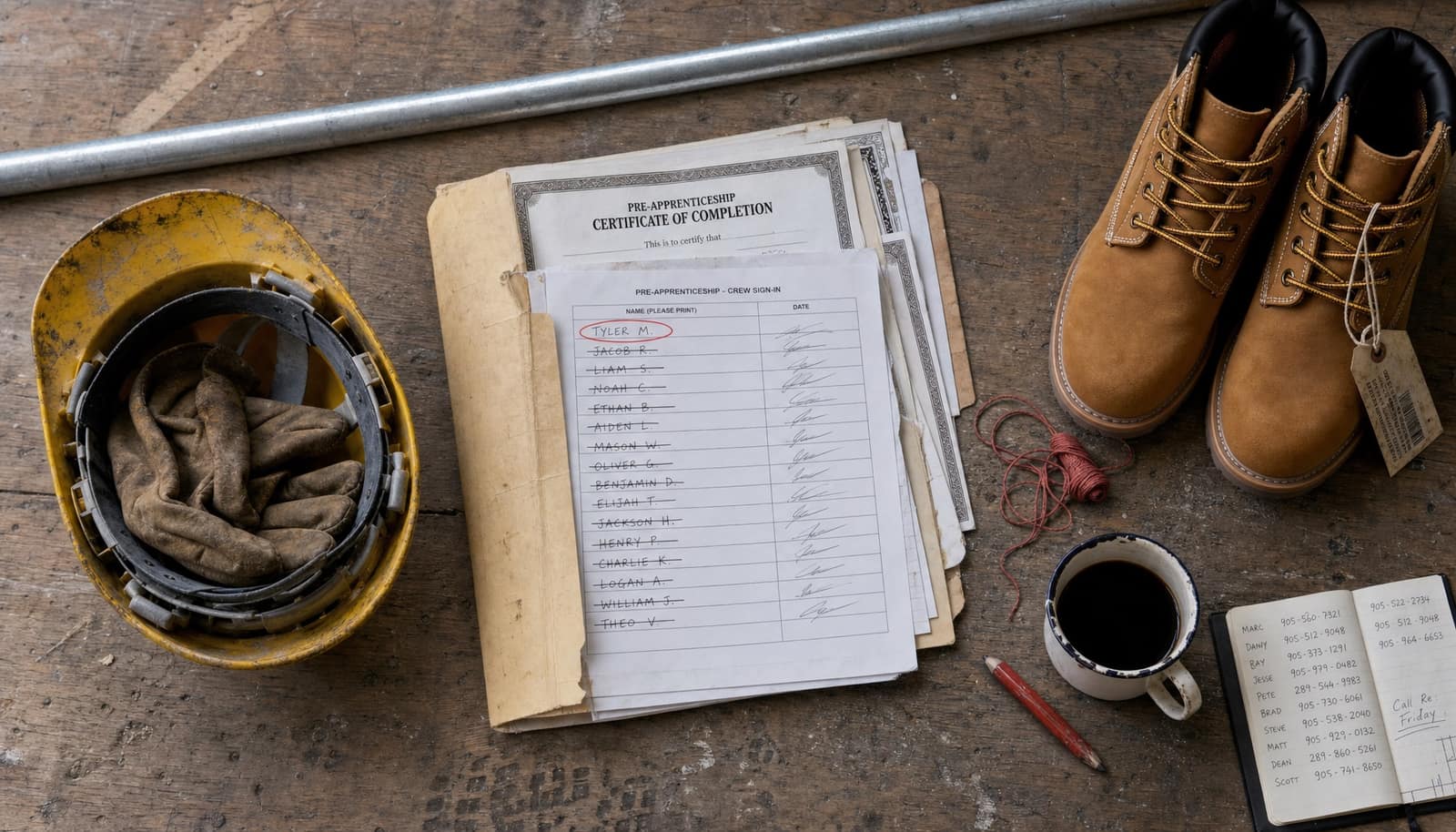
It doesn’t matter that your grandpa taught you how to run a table saw, or that you rebuilt your cousin’s Subaru, or that you aced electrical theory in a pre-apprenticeship program. You don’t get to skip the grunt work. Most people keep doing it for years even as they pick up the technical tasks.
You don’t get to skip ahead and leave the grunt work to others. Nobody does.
Progress is probable
Start at the bottom with a professional attitude and the trades will open up for you. Career progression in the trades is unusual that way: in a lot of jobs, advancement is rare or impossible. In the trades, for someone who’s consistently professional, the opportunities pile up faster than they can handle them.
It won’t happen right away. You’ll need to get comfortable with delayed gratification, which turns out to be a useful skill well past the jobsite. It’s tied to better outcomes in pretty much every part of life.
But none of that progression starts until you’re signed. Even with the critical shortage, that step is still the bottleneck. At Trade Smart College, we don’t accept a student into the program unless we have an apprenticeship opportunity lined up for them. That’s the part of the process most schools won’t touch.
What this means if you’re trying to get in
More people are looking at the trades than ever, and that’s a good thing. The hard step is still the same one it’s always been. Companies are slow to make the investment in a new apprentice unless that person has shown they’ll be a professional and that they get the value of starting at the bottom.
We currently have apprenticeship opportunities in all five trades we support for the upcoming semesters. Book an info session, or come by the shop.