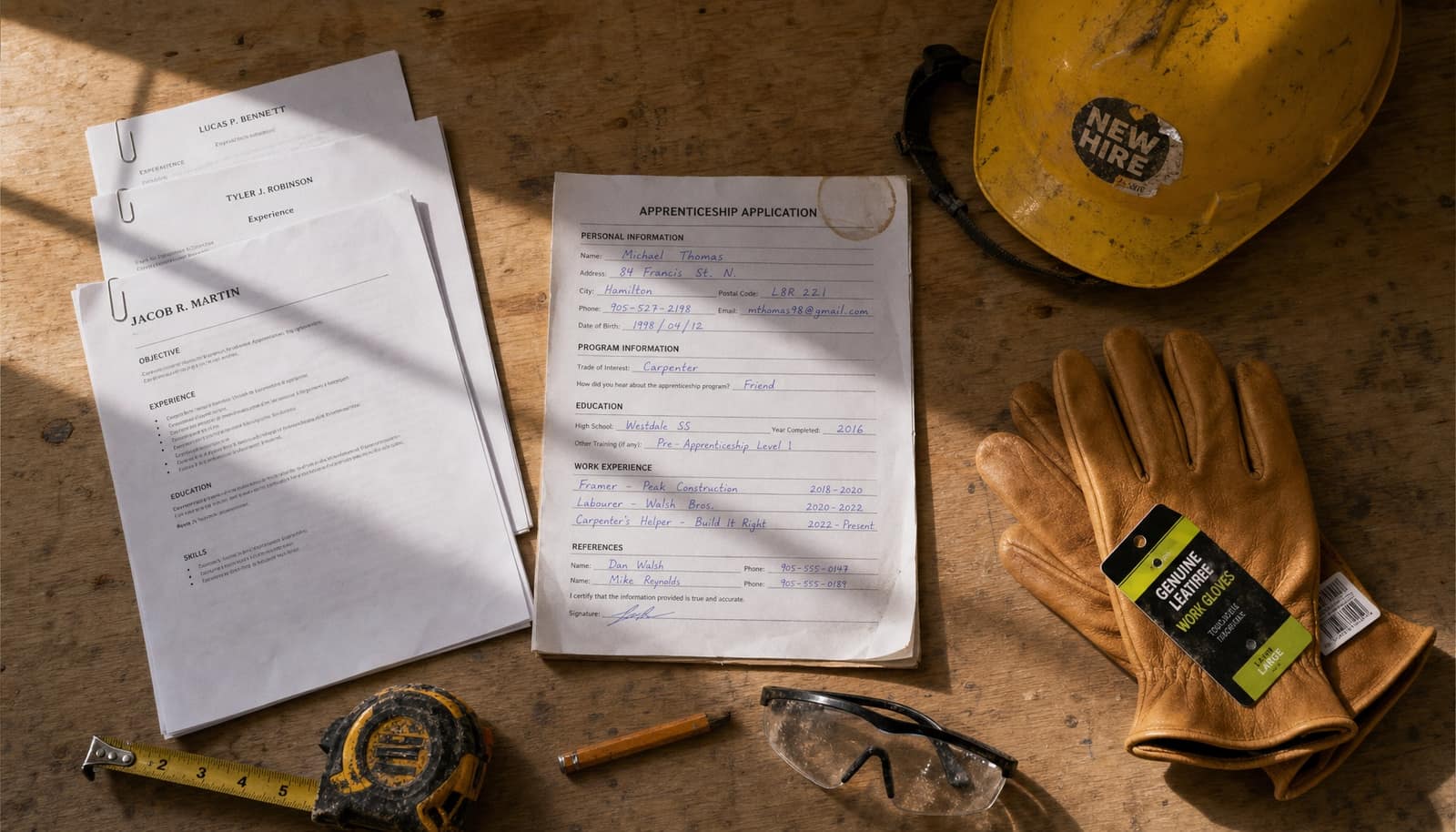
The four steps, on paper
We get this question almost every day. Someone wants into the trades, they’ve done the Google search, and they still can’t picture how it actually works. The Ontario government website lists four steps to start an apprenticeship: find out if you qualify, find an employer or sponsor, apply for an apprenticeship, sign a Training Agreement.
Step one is mostly a checkbox. You need to be 16, you need legal permission to work in Canada, and depending on the trade you may need a high school diploma. The bar is intentionally low. Apprenticeship is education first, work second. That’s the whole point.
Step two is the one that breaks people.
If you can find a company or a union willing to sponsor you, the rest is paperwork. You apply, you sign the Registered Training Agreement, and you’re an apprentice.
If only it were that simple.
Step two is a doozy
The four-step list is technically correct and practically useless. It’s like telling someone there are four steps to running a marathon: buy shoes, train, sign up, finish the race. A marathoner would pat you on the head.
The same is true here. Knowing the steps doesn’t get you signed. Step two is where almost everyone stalls, and it’s harder than learning the technical skills of the trade, harder than the C of Q exam in a compulsory trade, harder than finding a job once you’re licensed.
Finding a sponsor is harder than learning the trade, harder than the licensing exam, harder than finding work once you’re a journeyperson.
You qualify. So do thousands of other people. That’s the problem.
Why the door is so narrow
Sponsoring an apprentice is expensive. A journeyperson has to stop being productive to teach. The apprentice makes mistakes that cost money to correct. Productivity drops on the crew. And if the apprentice quits in week two, which happens often, the shop eats the whole bill.

So when a company posts an opening and gets 200 applications back, all with roughly the same qualifications, they have no rational way to pick. Most have been burned before. The sensible move is to pick someone with a connection to the organization. Is your uncle in the union? Does a family friend own a plumbing shop? Then you’ve got a real shot.
If you don’t have that connection, your odds are abysmal.
What to do without a connection
Relying on family ties is rational for the shops. It’s also the reason the trades stay closed off to people from outside, why diversity numbers don’t move, and why we can’t fill the labour gap. Two common workarounds exist, and both have problems.
The first is to take a pre-apprenticeship program at a college, learn some baseline skills, and look for a sponsor on your own afterward. You graduate alongside dozens of classmates competing for the same handful of openings.
The second is to hire on as a general labourer and hope a sponsorship eventually opens up on the crew. Some labourers wait years. For some, the offer never comes.
We don’t admit a student until we’ve already secured an apprenticeship opportunity for them.
That’s the part of our model that’s different. We don’t guarantee anyone will become an apprentice. You still have to earn it once you’re in the room. But you’re not chasing a position that doesn’t exist yet.
Where this leaves the sector
Ontario needs more than 100,000 new tradespeople in the next five years. The path to get there runs through step two, and step two is broken for anyone without a family connection to a shop or a local.
If you have a connection, use it. That’s not cynical advice. It’s the most direct route in.
If you don’t, get in touch. We currently have companies offering apprenticeship opportunities across five trades, and the door isn’t standing open for long.