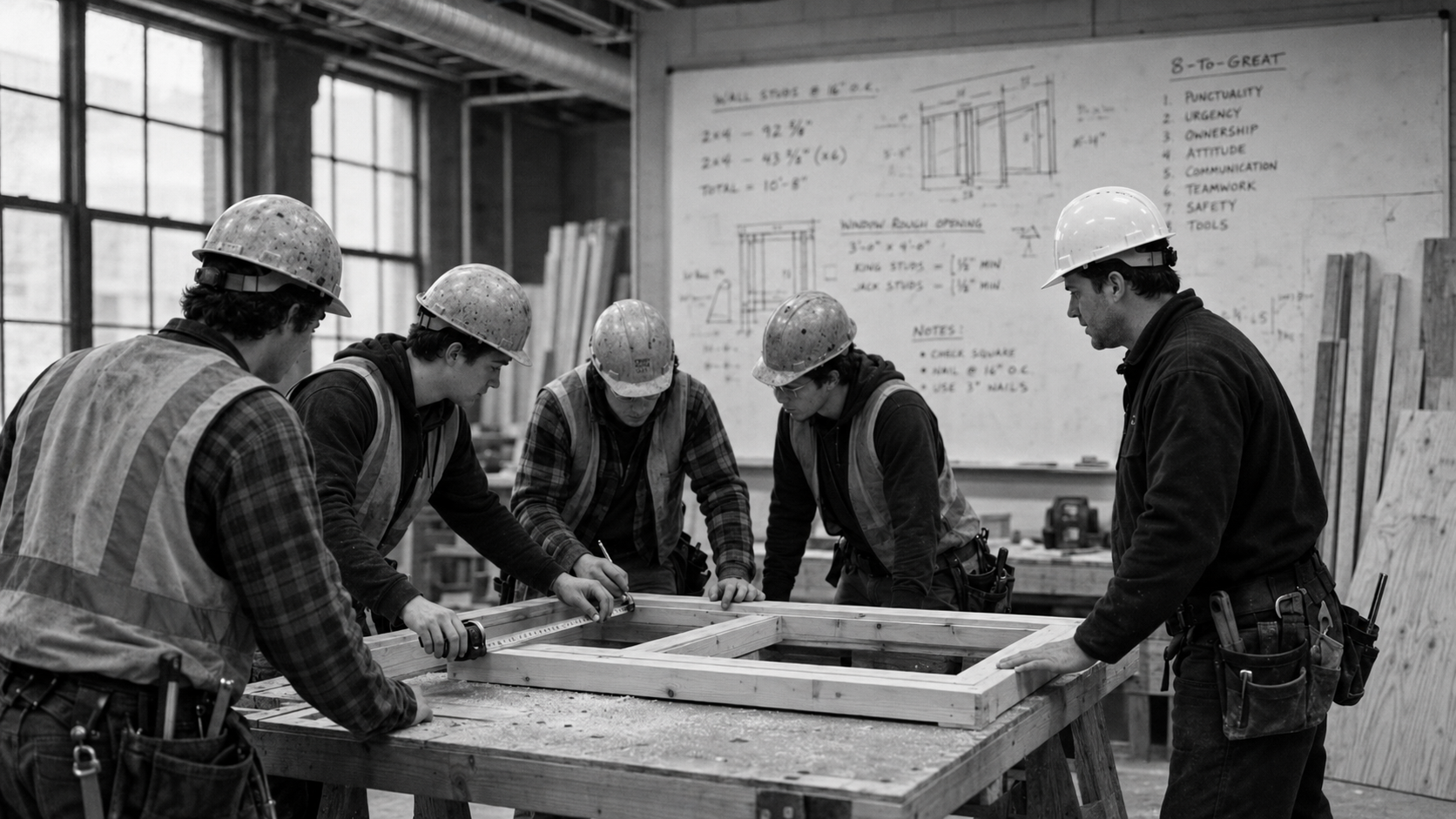
We teach work ethic.
Some companies say to us, “You can’t teach work ethic.” That’s not entirely true, because work ethic is not a personality trait, or a single skill.
Work ethic can be broken down into its components: the specific attitudes and behaviours that make companies trust someone. We’ve codified the 8 major competencies that make up work ethic, and we train you in them every day.
The 8-to-Great
Work ethic, codified 8 competencies
TECHNICAL 2 of 8
- Safety and Hazard Awareness
- Tool and Measurement Competence
PROFESSIONAL 6 of 8
- Punctuality, Attendance, Organization
- Sense of Urgency
- Sense of Ownership
- Exemplary Attitude
- Professional Communication
- Teamwork
Every trade starts with the same foundations.
Whatever trade you end up in, companies ask for the same things first. So that is where you start.
- The traditional path
- Most trades programs make you pick a trade before you enroll. Then you spend months in classrooms and workshops and hope you get a job when you graduate.
- The Trade Smart path
- You explore all of your options, not just the ones you’ve heard of, learn the skills companies in every trade look for, and earn a paid internship to start your career.
-
Getting started in any trade
Every trades company or union requires professionalism first. Punctuality, attitude, work ethic, communication, teamwork, safety, and basic tool competence. Whether it’s a construction crew, union hall, service truck, or a fabrication shop, these foundations do not change.
-
Trade-specific and company-specific skills
Each trade has some unique skills and know-how, but each company also has its own way of using these skills. A workshop can teach the foundations. That combination is learned on a real crew, under a real mentor, on real work.
-
Our approach: workshops and worksites
The most important requirement for getting a job in any trade is work experience. You’ll spend eight weeks in class, in our workshop, learning the professional, technical, and safety foundations of every trade. Pass the in-class portion and you have our commitment to find you a paid, 950-hour internship, where you’ll learn the specifics of a trade working in a real company. The company interviews you and decides. So you learn hands-on in both places: our workshop first, then a real worksite, where you’re paid to learn.
Not sure which trade yet? Start with how it actually works.
Start Trades MatchWhat you learn, week by week.
Class runs like a jobsite: 7:15 AM to 4:05 PM, Monday to Friday. The technical side builds one week on the next, and the professional side runs beside it the whole way.
TECHNICAL PROFICIENCY
You learn the technical side in order. Each week is the foundation for the next, so your confidence builds with your skills, one earned step at a time.
TECHNICAL
-
W1. Trades math and measurement
Tape work to the sixteenth, squares, levels and chalk lines, take-offs and cut lists, across lumber, drywall, foam, PVC and metal. A trades math drill runs in every lab for all eight weeks.
-
W2. Hand tools
Hammers and fasteners, hand saws, knives, snips and hacksaws, adhesives and tapes, used across different materials.
-
W3. Power tools
Circular, mitre and table saws, reciprocating saws, drills and impact drivers, grinders, compressors and air nailers. Guards, kickback and set-up come first, then repeat cuts and fastening patterns.
-
W4. An individual build exercise
Working alone from a drawing, to a standard, before working on a crew. One drawing and one tolerance sheet. Each student completes a build and submits it with the correct paperwork.
-
W5 to W7. A team build exercise, from framing through rough-ins to finishing
One wall, built in crews with rotating roles. Students learn how to work together and how one trade hands off a project to the next team.
-
W8. Site readiness
Setting up and closing down a site, outside and inside: layout, staging, safety controls, waste, floor protection, dust containment and working in occupied spaces. Understanding of the way a real jobsite runs.
PROFESSIONAL SKILLS
These run beside the technical work for all eight weeks. All of it is practice, not customer work, so class is the place to make your mistakes and fix them.
PROFESSIONAL
-
Self-leadership.
Leading and following, habits, mindsets and better decisions: the professional skills that make a crew trust you when you’re new.
-
Building Empathy.
You build a trades business on paper, so you see everything it takes to run one. Seeing it from the owner’s side makes you a better member of a crew.
-
Customers and Sales.
You plan, price and present a full customer bid, so you see the work involved and how every jobsite depends on sales.
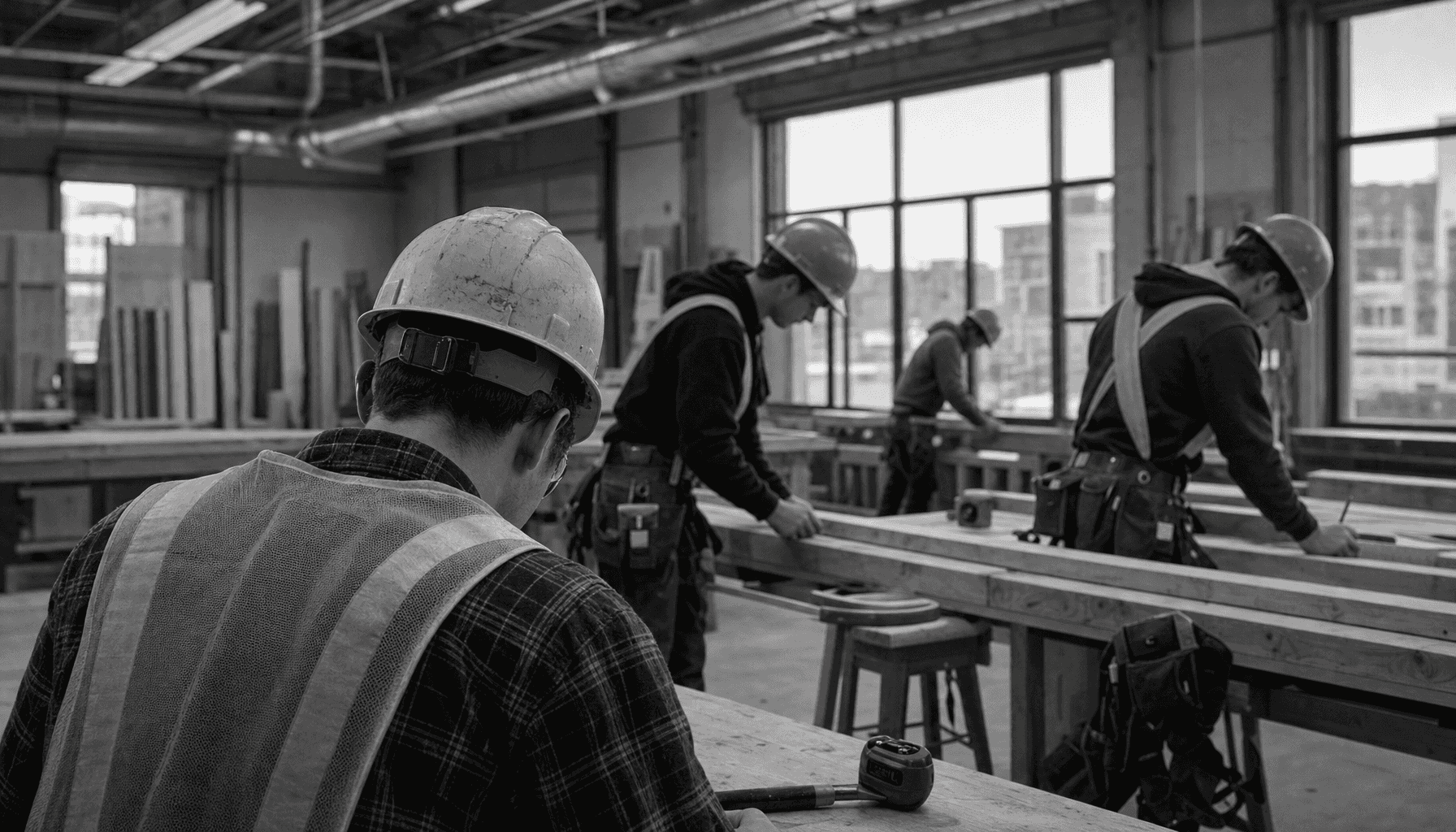
The 8-to-Great. Scored every Friday.
You’re scored every week against these eight competencies, to show you can be trusted enough to go on an internship. Two are technical and six are professional. A failing score on any one triggers corrective action right away, just like on a jobsite. Pass all eight and you’re eligible for an internship.
TECHNICAL 2 of 8
-
Safety and Hazard Awareness
WAH, WHMIS, Lockout/Tagout, Confined Spaces, Habitat Safety, Worker Health and Safety in 4 Steps, Master Your Backpack hazard awareness.
-
Tool and Measurement Competence
Pass all Master Your Backpack exercises and evaluations on using the tools in your backpack, plus additional tools as required. Measure, mark and cut precisely.
PROFESSIONAL 6 of 8
-
Punctuality, Attendance, Organization
Show up early every day in uniform, log into the portal, phone in jail, demonstrate that class/company time is more important than personal time. Quickly learn company systems and use them.
-
Sense of Urgency
Company/College time is valuable. You must demonstrate that this matters to you. Quick responses to all college/company requests, persistence, effort and speed on tasks, unafraid of hard or uncomfortable work.
-
Sense of Ownership
Act like you care about what happens to the company. Insist on quality, own your mistakes right away, do the hard or unpleasant things before you’re asked. Wholistically own your tasks and outcomes.
-
Exemplary Attitude
After showing up on time, companies look for people who want to be there and are willing to work. Employees who do their work quickly, properly, and with a smile, regardless of how unpleasant the task, are the ones who succeed. Having a great attitude starts with losing your ego and deliberately cultivating a customer-ready presence.
-
Professional Communication
Everything you say and do on a jobsite reflects on the company. You must be professional and polished in everything you write, do, and communicate, and you must be able to document the work you do.
-
Teamwork
Trades work is team work. Every company is always looking for good team members who exhibit all of the qualities listed above. You must be the person everyone wants on their team.
Everyone starts at 1.
In week one, everyone scores a 1 or 2 in every category. You earn every increase, just like on a jobsite, and a score can go down if you make mistakes or don’t keep up the standard.
How scoring works in class. A worked example.
The weekly scorecard,
at a glance.
Professional 6 of 8
The behaviours that make a company trust you before you ever pick up a tool: how you show up, own your work, communicate, and carry a crew.
- PUNCT Punctuality, attendance, organization 9/10
- URG Sense of urgency 8/10
- OWN Sense of ownership Correcting 6/10
- ATT Exemplary attitude 9/10
- COMM Professional communication Correcting 6/10
- TEAM Teamwork 8/10
Technical 2 of 8
The hands-on fundamentals every trade expects from day one: working safely, and measuring, marking, and cutting with precision.
- SAFETY Safety & hazard awareness 9/10
- TOOL Tool & measurement competence 7/10
Then earn a paid internship. 950 hours with a real company.
Pass the in-class portion and you have our commitment to find you a paid internship. The company interviews you and decides. Then you have about six months to show them you want to be there and can add value, and you’re paid from day one.
- Weeks 1 to 8 In class 7:15 AM to 4:05 PM, Monday to Friday. Scored every Friday.
- About six months Paid internship Pass the in-class portion. 950 hours with a company, paid from day one.
- Graduation Your diploma

Clarity comes from a simple plan.
Figuring out how to pay for your schooling before the earning potential of a paid internship can be confusing. In most cases, students rely on multiple sources to cover tuition and living expenses. We can help.
Get clarity on how to fund your education at Trade Smart College with a simple plan. We walk every applicant through the same five-step process so your funding picture is clear, not a question mark.
- Meet With Our Student Success Manager
- Complete Your Education Funding Worksheet
- Calculate Your Funding Gap
- Review Short-Term Funding Solutions
- Confirm Your Plan Before You Start

Find out if this fits you.
Before you commit to anything, see how the system works and where you’d start in it. Trades Match shows you the role you’d play on any crew and your starting stats on the eight things companies decide on.